FORWARDS welcomes the last batch of third-party projects

All FORWARDS calls for grants to third parties are now closed, and the last batch of new projects is now under way.
The final call fell under Theme 5, Knowledge to Practice: Develop applications and AI solutions utilising the ForestWard Observatory. It invited proposals for applications that use or enrich the Observatory’s datasets, or for data collection systems that can be integrated with it. Two projects were selected for funding: ForestMind and FORWARDS-3D. Both started in July 2026 and will run for ten months. On 16 September, the project teams met FORWARDS partners at an online kick-off meeting to present their plans and ideas.
ForestMind (3Bee S.r.l.)
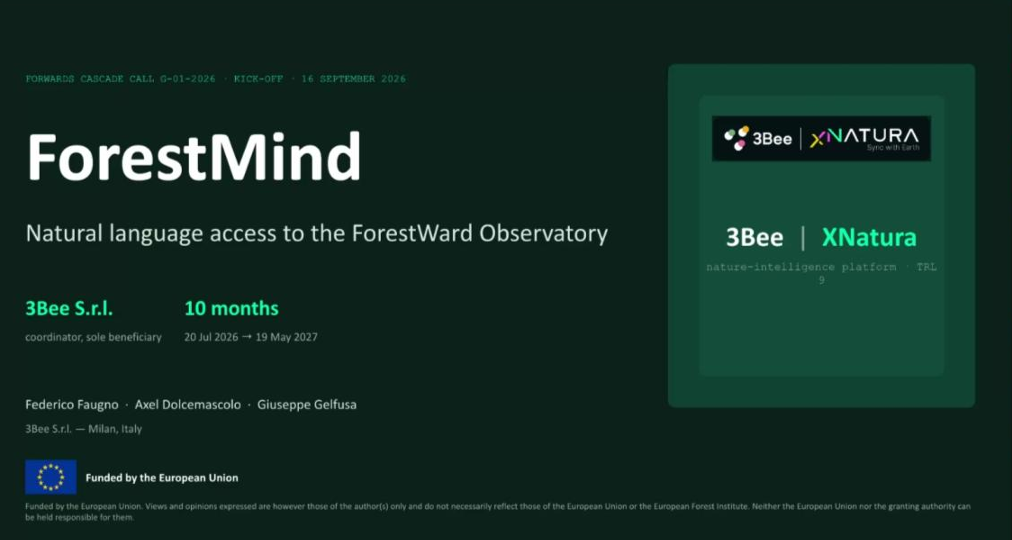
The ForestWard Observatory brings together key forest data from across Europe. However, using these varied datasets often requires GIS and programming skills, which limits uptake among the practitioners and policymakers who need them most. ForestMind addresses this with a system of AI agents that lets users ask the Observatory questions in plain language. Each agent specialises in one data domain, such as species distributions, biomass, disturbance maps, ICOS super-sites or field inventories. A coordinator agent routes each question to the right specialist and combines the answers into structured reports with maps, charts and statistics. A scheduler can also run recurring analyses and send the results by email or messaging app. The system connects to the Observatory only through its public APIs. It builds on a geospatial AI agent that 3Bee already runs on its XNatura platform. All outputs will be released open source under the Apache 2.0 licence, in line with the FAIR principles.
FORWARDS-3D (University of Freiburg)
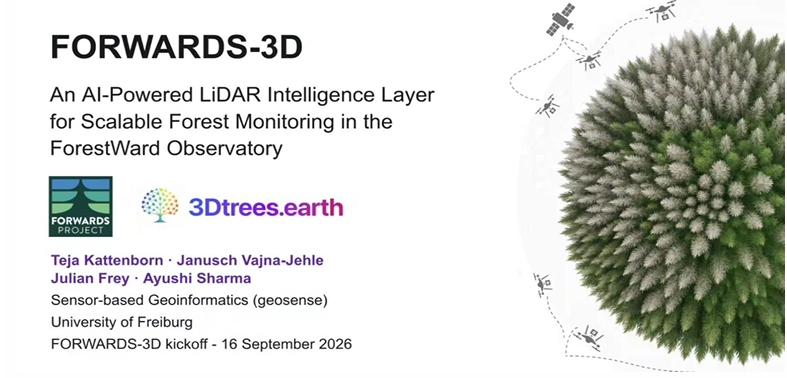
Traditional forest inventories are too sparse, in both space and time, to capture how forest structure is changing under climate pressure. This limits local monitoring and the calibration and validation of Earth Observation products. FORWARDS-3D integrates 3Dtrees.earth, an emerging platform that combines crowd-sourced LiDAR data with AI-based analysis, into the ForestWard Observatory. The project will add LiDAR analytical services to the Observatory’s data pipeline, including tree segmentation, species classification and structural diversity metrics. These services run on Galaxy Europe’s computing infrastructure, so non-expert users can process their own point clouds without specialist skills or local computing resources. A dedicated data auditing and feedback system will check that integrated datasets meet FORWARDS quality standards, with provenance tracking and FAIR-compliant workflows. By mobilising LiDAR data from across Europe, the project will strengthen the Observatory’s capacity to support climate-smart forest management.